This post is based primarily on Don's notes, occasionally supplemented with MT's notes from our cruise in November-December 2023. When information from other sources is added—for further explanation to readers or to satisfy our own curiosity—that is set off in a text box (as this one).
Most of the photos that accompany this post are from Don’s camera (with a caption indicating the time it was taken); those from MT’s iPhone are indicated by “MT” placed at the beginning of the photo caption. Photos from any other source (such as the public domain Wikimedia Commons), occasionally used for clarification, indicate that source in the caption.
Most of the photos that accompany this post are from Don’s camera (with a caption indicating the time it was taken); those from MT’s iPhone are indicated by “MT” placed at the beginning of the photo caption. Photos from any other source (such as the public domain Wikimedia Commons), occasionally used for clarification, indicate that source in the caption.
The Viking Daily newsletter showed today's weather forecast as "Cloudy 84° F" and "Sunrise: 6:18 AM."
We got up around 6:00 am.

Wednesday, November 29, 2023, 7:02 AM - Tahiti: first view of land from our veranda.
The Viking Daily newsletter
describes our stop at “Tahiti (Papeete), French Polynesia” as follows:
“One of the world’s most visually stunning and romantic destinations and the
cultural hub of French Polynesia, Tahiti is perhaps the archipelago’s most
famous island. It is easy to imagine the astonishment of English captain Samuel
Wallis when he came upon it in 1767, the first European to do so. But he
certainly was not the last, as the island’s continental flavor will attest.
Here, swaying palms skirt dramatic mountains, striking a breathtaking pose in
shimmering Pacific waters. While in downtown Papeete, awe-inspiring
architecture displays its glory—from the arched stained glass windows of Notre
Dame Cathedral to the neoclassical design of the palatial Town Hall, it is no
wonder luminaries such as Paul Gauguin and James Norman Hall found the island so
inspiring.”
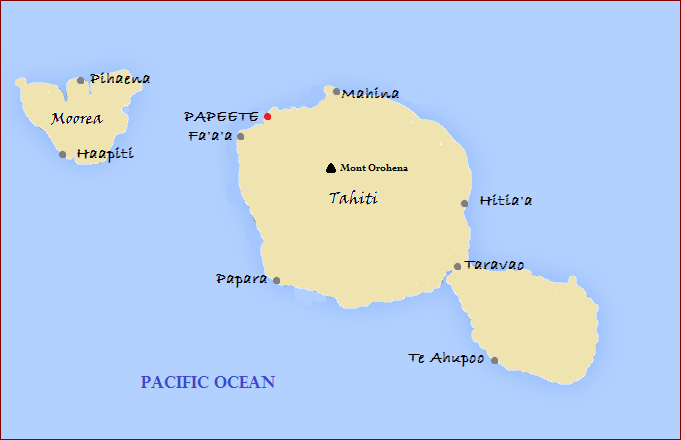
Tahiti (Tahitian:
Ta’hiti) is the largest island of the Windward group of the Society Islands in
French Polynesia. It is divided into two parts, Tahiti Nui (meaning “big
Tahiti,” the larger, northwestern part) and Tahiti Iti (meaning “small
Tajhiti,” the smaller, southeastern part). These two roughly round parts are
centered on two basalt shield volcanic mountains and connected by the short
isthmus of Taravo. Tahiti Nui is heavily populated along the coast, especially
around the capital, Pape’ete. The interior of Tahiti Nui is almost entirely
uninhabited. Tahiti Iti has remained isolated, and its southeastern half (Te
Pari) is accessible only to those travelling by boat or on foot. The rest of
the island is encircled by a main road that cuts between the mountains and the
sea. The highest peak is Mount Orohena (Mou’a ‘Oruhena) at 7,352 ft. Mount
Roonui or Mount Ronui (Mou’a Ronui) in the southeast rises to 4,370 ft.
%20jpg.png)
Map of Tahiti, also showing Moorea at upper left (https://upload.wikimedia.org/wikipedia/commons/2/2c/Tahiti_Map.PNG)Changed to jpg.
The island was formed from volcanic
activity; it is high and mountainous with surrounding coral reefs. With a
population of 191,779, it is by far the most populous island in French
Indonesia. Pape’ete, the capital of French Polynesia, is located on the
northwest coast of Tahiti.
Tahiti was originally settled by migrating Polynesians. They still represent about 70 % of the island’s population. The island was part of the Kingdom of Tahiti until its annexation by France in 1880, when it was proclaimed a colony of France, and the inhabitants became French citizens. Tahiti as called Otaheite in earlier European documents. French is the sole official language, although the Tahitian language is also widely spoken.
Early Settlement
The first Tahitians arrived from Western Polynesia sometime around 500 BC (some sources say 400 AD). Linguistic, biological, and archaeological evidence supports a long migration from Southeast Asia via the Fijian, Samoan, and Tongan archipelagos using large outrigger canoes that could transport families as well as domestic animals. Before the arrival of Europeans, the island was divided into territories, each dominated by a single clan.
First European Visits
The first Europeans to arrive at Tahiti may have been Spanish or Portuguese explorers in the late 16th or early 17th century. The next stage of European visits to the region came between the period of intense Anglo-French rivalry in the 12 years between the Seven Years’ War and the American Revolution (i.e., 1763-1775).
Bounty Mutineers and the Pomare Dynasty
In 1788, the HMS Bounty, under the command of Captain William Bligh, landed in Tahiti looking for breadfruit trees to carry to the Caribbean. Three weeks after leaving Tahiti with seedlings, the crew mutinied on the initiative of Fletcher Christian. A group of mutineers then went back to settle in Tahiti, after which the Bounty, under Christian, sailed to Pitcairn Island. Although various explorers had refused to get involved in tribal conflicts, the mutineers offered their services as mercenaries and furnished arms to the family of chief Tū. As a result of his alliance with the mutineers, chief Tū succeeded in considerably increasing his supremacy over the island of Tahiti. Around 1790, he took the title of king and gave himself the name Pomare. Thus, he became Pomare I, founding the Pomare Dynasty. He and his descendants founded and expanded Tahitian influence to all the lands that now constitute modern French Polynesia.
Unwelcome Visitors
In the 1790s, whalers began landing at Tahiti, soon joined by merchants coming from the penal colonies of Australia. These interactions with westerners introduced infectious diseases that were catastrophic for the Tahitian population, which shrank rapidly.
English Missionaries
In 1797, representatives of the London Missionary Society landed in Tahiti with the mission of converting the natives to Christianity. The arrival of these missionaries marked a new turning point for Tahiti, having a lasting impact on the local culture. Following the death of Pomare I in 1803, his son Pomare II allied himself more and more with the missionaries. The conversion of Pomare II to Protestantism in 1812 marked the point when Protestantism really took off on the island. In the 1820s, the entire population of Tahiti converted to Protestantism. In 1835, Charles Darwin visited Tahiti aboard the HMS Beagle and was impressed by what he perceived to be the positive influence of the missionaries on the sobriety and moral character of the population.
French Protectorate and the End of the Pomare Kingdom
In 1842, a French admiral landed in Tahiti and made friends with Tahitian chiefs who were hostile to the Pomare family and favorable to a French protectorate. Within the framework of the protectorate, France recognized the sovereignty of the Tahitian state. However, while Queen Pomare IV was responsible for internal affairs, the French commissaire (commisioner or governor) would deal with foreign relations and assure the defense of Tahiti. In 1843, the French admiral announced the annexation of the Kingdom of Pomare. During the first years of the Protectorate, the Protestants managed to retain a considerable hold over Tahitian society, striving to indoctrinate the locals against the Roman Catholic French. The Tahitian War of Independence (1844-47) ended in favor of the French, resulting in an end to the British influence. In 1863, the French replaced the British Protestant Missions with the Protestant Mission Society of Paris.
Late 19th Century
After the death of Queen Pomare IV in 1877, her son Pomare V seemed little concerned with the affairs of the kingdom. When the French governor, supported by other Tahitian chiefs, pushed him to abdicate in favor of France, he accepted and in 1880 ceded Tajhiti to France.
20th Century
In 1903, the Établissements français d'Océanie (French Establishments of Oceania) or EFO were created, including Tahiti, the other Society Islands, and other islands. In 1946, Tahiti and the whole of French Polynesia became an autonomous overseas territory of France.
%20jpg.png)
Map of Tahiti, also showing Moorea at upper left (https://upload.wikimedia.org/wikipedia/commons/2/2c/Tahiti_Map.PNG)Changed to jpg.
Tahiti was originally settled by migrating Polynesians. They still represent about 70 % of the island’s population. The island was part of the Kingdom of Tahiti until its annexation by France in 1880, when it was proclaimed a colony of France, and the inhabitants became French citizens. Tahiti as called Otaheite in earlier European documents. French is the sole official language, although the Tahitian language is also widely spoken.
Early Settlement
The first Tahitians arrived from Western Polynesia sometime around 500 BC (some sources say 400 AD). Linguistic, biological, and archaeological evidence supports a long migration from Southeast Asia via the Fijian, Samoan, and Tongan archipelagos using large outrigger canoes that could transport families as well as domestic animals. Before the arrival of Europeans, the island was divided into territories, each dominated by a single clan.
First European Visits
The first Europeans to arrive at Tahiti may have been Spanish or Portuguese explorers in the late 16th or early 17th century. The next stage of European visits to the region came between the period of intense Anglo-French rivalry in the 12 years between the Seven Years’ War and the American Revolution (i.e., 1763-1775).
Bounty Mutineers and the Pomare Dynasty
In 1788, the HMS Bounty, under the command of Captain William Bligh, landed in Tahiti looking for breadfruit trees to carry to the Caribbean. Three weeks after leaving Tahiti with seedlings, the crew mutinied on the initiative of Fletcher Christian. A group of mutineers then went back to settle in Tahiti, after which the Bounty, under Christian, sailed to Pitcairn Island. Although various explorers had refused to get involved in tribal conflicts, the mutineers offered their services as mercenaries and furnished arms to the family of chief Tū. As a result of his alliance with the mutineers, chief Tū succeeded in considerably increasing his supremacy over the island of Tahiti. Around 1790, he took the title of king and gave himself the name Pomare. Thus, he became Pomare I, founding the Pomare Dynasty. He and his descendants founded and expanded Tahitian influence to all the lands that now constitute modern French Polynesia.
Unwelcome Visitors
In the 1790s, whalers began landing at Tahiti, soon joined by merchants coming from the penal colonies of Australia. These interactions with westerners introduced infectious diseases that were catastrophic for the Tahitian population, which shrank rapidly.
English Missionaries
In 1797, representatives of the London Missionary Society landed in Tahiti with the mission of converting the natives to Christianity. The arrival of these missionaries marked a new turning point for Tahiti, having a lasting impact on the local culture. Following the death of Pomare I in 1803, his son Pomare II allied himself more and more with the missionaries. The conversion of Pomare II to Protestantism in 1812 marked the point when Protestantism really took off on the island. In the 1820s, the entire population of Tahiti converted to Protestantism. In 1835, Charles Darwin visited Tahiti aboard the HMS Beagle and was impressed by what he perceived to be the positive influence of the missionaries on the sobriety and moral character of the population.
French Protectorate and the End of the Pomare Kingdom
In 1842, a French admiral landed in Tahiti and made friends with Tahitian chiefs who were hostile to the Pomare family and favorable to a French protectorate. Within the framework of the protectorate, France recognized the sovereignty of the Tahitian state. However, while Queen Pomare IV was responsible for internal affairs, the French commissaire (commisioner or governor) would deal with foreign relations and assure the defense of Tahiti. In 1843, the French admiral announced the annexation of the Kingdom of Pomare. During the first years of the Protectorate, the Protestants managed to retain a considerable hold over Tahitian society, striving to indoctrinate the locals against the Roman Catholic French. The Tahitian War of Independence (1844-47) ended in favor of the French, resulting in an end to the British influence. In 1863, the French replaced the British Protestant Missions with the Protestant Mission Society of Paris.
Late 19th Century
After the death of Queen Pomare IV in 1877, her son Pomare V seemed little concerned with the affairs of the kingdom. When the French governor, supported by other Tahitian chiefs, pushed him to abdicate in favor of France, he accepted and in 1880 ceded Tajhiti to France.
20th Century
In 1903, the Établissements français d'Océanie (French Establishments of Oceania) or EFO were created, including Tahiti, the other Society Islands, and other islands. In 1946, Tahiti and the whole of French Polynesia became an autonomous overseas territory of France.

7:02 AM - Tahiti: view, from our veranda, of waves breaking on reef.

7:03 AM - Pape'ete: view, from Track on Deck 2, of cruise ship port.

7:04 AM - Pape'ete: view, from Track on Deck 2, of pilot boat approaching aft end of Viking Star.
We were scheduled to arrive at the Main Cruise Pier in Pape'ete at 8:00.
Papeete (Tahitian: Pape’ete)
is the capital city of Tahiti and of French Polynesia. The commune of Pape’ete
is located on the northwest coast of the island of Tahiti. It is in the administrative
subdivision of the Windward Islands, of which Pape’ete is the administrative
capital. The old name of this town was Vai’ete. The name Pape’ete means “water
from a basket.” This was a result of a naming taboo during the reign of Pomare
I, where the Tahitian word for water (vai) was substituted with pape.
Pape’ete is one of the largest urban centers in the South Pacific. Its
excellent harbor made it, by the 1830s, a place of trade and a favorite port of
call for whalers. After the annexation of Tahti by the French in 1880, it was
made the seat of the governor, and in 1890 it became a commune. (A commune is a
level of administrative division in the French Republic, analogous to civil
townships and incorporated municipalities in the US.) The commune proper has a
population of 26,654, and the urban area of Pape’ete has a total population of
124,724.

7:04 AM - Pape'ete: view, from Track on Deck 2, of cruise ship port.

7:12 AM - Pape'ete: view, from Track on Deck 2, of town near cruise ship port.

MT 7:14 AM - Pape'ete: view, from Track on Deck 2, of town and mountains near cruise ship port (mild telephoto 39 mm).

MT 7:14 AM - Pape'ete: view, from Track on Deck 2, of town near cruise ship port, with Paofai Protestant Church at far right (mild telephoto 60 mm).
The Temple Paofai (Paofai
Protestant Church) is considered to be the heart of the Evangelical Church in
French Polynesia. It is located across from the Paofai Gardens, near the
seafront, slightly off the main road (Boulevard de la Reine Pomare IV). It has
peach-colored walls and a pale green roof. The windows of the building have
plain white pointed arches.The bell tower has a larger window, a clock, and a
high, pointed spire.
.jpg)
Pape'ete: Temple Paofai (Par Saga70 — Travail personnel, CC BY-SA 4.0, https://commons.wikimedia.org/w/index.php?curid=94247463).
The church traces its foundation to
1797, when Protestant missionaries of the London Missionary Society landed in
Tahiti. In 1820, the first chapel, made of woven bamboo, was built. In 1908, a
new, larger building was inaugurated, built of stones from the nearby Tumarama
marae (traditional Polynesian open-air temple). In 1981, a new temple was
built, preserving only the bell tower-porch of the 1908 building.
.jpg)
Pape'ete: Temple Paofai (Par Saga70 — Travail personnel, CC BY-SA 4.0, https://commons.wikimedia.org/w/index.php?curid=94247463).
From 7:15 to 8:15, we both walked around the Track on Deck 2.
At 8:15, we went to the World Café (Deck 7) for breakfast.
At 11:00, we went to the meeting place on the pier for our (included) shore excursion "Walking Tour of Papeete."
The My Viking Journey web site
described “Walking Tour of Papeete” shore excursion as follows:
INCLUDED
Day 20 – Tahiti (Papeete), French Polynesia
Wednesday, November 29
8:30 AM / 11:30 AM / 2:45 PM
2.5 Hours
MODERATE
SIGHTSEEING
An Intimate View of Tahiti’s Tropical City
Get to know the capital of French Polynesia up close and personal during a walking tour.
One of the world’s most visually stunning and romantic destinations, Tahiti is perhaps the archipelago’s most famous island. Meet your guide and set off to discover Papeete’s major sites and monuments. At the municipal market, explore colorful stalls filled with fresh produce, regional delicacies, Tahitian pearls, and local arts and crafts. Walk past the Town Hall, a replica of the former Royal Palace, and Notre Dame Cathedral—one of the oldest and largest churches in Papeete. See the Territorial Assembly, home to the Polynesian Parliament and the French High Commissioner’s residence, and admire the edifice which reflects Tahiti’s traditional building style. Cap your tour with a stroll through Parc Bougainville, dedicated to explorer Louis Antoine de Bougainville.
INCLUDED
Day 20 – Tahiti (Papeete), French Polynesia
Wednesday, November 29
8:30 AM / 11:30 AM / 2:45 PM
2.5 Hours
MODERATE
SIGHTSEEING
An Intimate View of Tahiti’s Tropical City
Get to know the capital of French Polynesia up close and personal during a walking tour.
One of the world’s most visually stunning and romantic destinations, Tahiti is perhaps the archipelago’s most famous island. Meet your guide and set off to discover Papeete’s major sites and monuments. At the municipal market, explore colorful stalls filled with fresh produce, regional delicacies, Tahitian pearls, and local arts and crafts. Walk past the Town Hall, a replica of the former Royal Palace, and Notre Dame Cathedral—one of the oldest and largest churches in Papeete. See the Territorial Assembly, home to the Polynesian Parliament and the French High Commissioner’s residence, and admire the edifice which reflects Tahiti’s traditional building style. Cap your tour with a stroll through Parc Bougainville, dedicated to explorer Louis Antoine de Bougainville.

11:18 AM - Pape'ete: our guide Gérald on the pier.

MT 11:22 AM - Pape'ete: Gérald talking to our tour group on the pier.

11:23 AM - Pape'ete: yellow fruit on tree near the pier.

11:24 AM - Pape'ete: view, from the pier, of Viking Star in port.

11:24 AM - Pape'ete: Gérald with red "lollypop" (paddle) for our "Viking Star 1" tour group and a basket with his visual aids.

11:24 AM - Pape'ete: lower floors of former Stuart Hotel where Matisse stayed.
The French artist Henri Matisse
(1869-1954) traveled to Tahiti in 1930, following in the footprints of his
great inspiration Paul Gauguin. However, Matisse said he was “more interested
in the search for light than in the painter Gauguin.”
In 1930, Matisse arrived in the Pape’ete harbor and stayed for 3 months at the Stuart Hotel, located on Boulevard de la Reine Pomare IV (Boulevard of Queen Pomare IV), next to the US Consulate. That hotel, owned by the Scotsman William Stuart, was the newest hotel in Pape’ete at that time. Matisse would stay for hours at his second-floor window facing the seafront with Motu Uta and Moorea. From these ink drawings, he produced paintings in 1935, including the famous “Window in Tahiti.” The Stuart was the tallest building of the time, allowing Matisse to dominate all of Pape’ete.
In 1930, Matisse arrived in the Pape’ete harbor and stayed for 3 months at the Stuart Hotel, located on Boulevard de la Reine Pomare IV (Boulevard of Queen Pomare IV), next to the US Consulate. That hotel, owned by the Scotsman William Stuart, was the newest hotel in Pape’ete at that time. Matisse would stay for hours at his second-floor window facing the seafront with Motu Uta and Moorea. From these ink drawings, he produced paintings in 1935, including the famous “Window in Tahiti.” The Stuart was the tallest building of the time, allowing Matisse to dominate all of Pape’ete.

MT 11:35 AM - Pape'ete: upper floors of former Stuart Hotel.

11:35 AM - Pape'ete: Sign at entrance to Parc Bougainville."
Parc Bougainville (Bougainville
Park) was renovated in 2003 with benches, tables, and a play area. Formerly called
the Place Publique de Papeete (Public Square of Papeete), it was once a place
where festivities and ceremonies were held, such as on June 29, 1880 when King
Pomare V ceded the Society Islands to France. In the 1840s, there were several colonial-era
administrative buildings in the park. In 1906, all of these buildings were
destroyed by a cyclone. The Post Office was rebuilt and remains the only
administrative building in the park. In 1934, the park was renamed Place Albert
1er (Albert I Square), in honor of the third king of Belgium (1875-1934). In
1968, a bronze bust of Louis Antoine de Bougainville (1729-1811), the French navigator
who in 1768 famously described Tahiti as a paradise untouched by the troubles
of civilization, was installed in the park, and the locals gradually took to
referring to the park by that name. To avoid a possible diplomatic incident
with Belgium, the Pape’ete town council passed a decree that formally baptized
the park Place Albert 1er. However, the local population never took to that
name, and eventually, in 2005, it was officially re-baptized “Parc Bougainville.”
The park stretches from Boulevard de la Riene Pomare IV along the seafront to Rue
du General de Gaulle, the next street away from the sea.

11:37 AM - Pape'ete: Parc Bougainville - thatched roof of open building.

11:37 AM - Pape'ete: Parc Bougainville - closer view of one side of thatched roof.

11:47 AM - Pape'ete: Parc Bougainville - statue of "Pouvana'a a Oopa" (mild telephoto 42 mm).
Pouvana'a a O’opa (1895-1977) was a
Tahitian politician and advocate for French Polynesian independence. In 1958 he
was convicted of charges of arson and sentenced to 8 years imprisonment and 15
years exile in France. After being pardoned in 1968, he served as a Senator
from 1971 until his death in 1977. His conviction was quashed in 2018 after new
evidence showed that French police had fabricated evidence and that the
Governor had reported Pouvana'a’s arrest before the fires had even been set. (Wikipedia)

11:51 AM - Pape'ete: Parc Bougainville - sign, in Tahitian, by statue of "Pouvana'a a Oopa" (telephoto 58 mm).

11:51 AM - Pape'ete: Parc Bougainville - sign, in French, on the other side of the statue of "Pouvana'a a Oopa" (telephoto 58 mm).
The French version of this sign
says Pouvana’a was “accuse d’avoir incite a búrler Papeete” (accused of
inciting the burning of Papeete) in 1958. It makes no mention of nuclear tests.

11:52 AM - Pape'ete: Parc Bougainville - Gérald showing us a yellow flower used behind the ear (after squeezing juice out).

11:54 AM - Pape'ete: Parc Bougainville - Sign for "Taraho'i au Fil de L'Histoire" (Taraho'i Throughout History); the entire sign is in French, but the picture shows the layout of the park.
Place Taraho’i (Taraho’i Square),
also known as the Territorial Assembly, houses the French Polynesian Assembly
and the Presidential Palace. It is surrounded by gardens and memorial statues. It
was built in the 1960s on the site of Queen Pomare IV of Tahiti’s residence. It
became the seat of power for the Pomare dynasty and later the administrative
center for the French government in French Polynesia after they took control in
1842. The surrounding gardens were once known as the royal gardens of Queen
Pomare IV.
The first residence of Queen Pomare IV here was a simple wooden house with no floors. In 1861, the French government agreed to help the queen build a new and vast palace. However, the project was found to be too ambitious and too expensive and was not completed until 1883, 6 years after the queen’s death and 3 years after the transformation of the kingdom into a French colony. Thus, this palace was never inhabited, but it was sometimes used for celebrations. In 1900, it was sold to a local merchant, but that raised so much criticism that the French administration bought it back and used it for government buildings. The building, with its thick cut stone walls, was still in excellent condition at the time of its demolition in 1966.
After the Royal Palace was destroyed, the current Assembly was built on the same site in 1969. Six years after the French colony became an Overseas Territory, this first representative assembly would become the Territorial Assembly of the EFO. In 1957, the Overseas Territory changed its name to French Polynesia. In 1996, the Territorial Assembly became the Assembly of French Polynesia.
The first residence of Queen Pomare IV here was a simple wooden house with no floors. In 1861, the French government agreed to help the queen build a new and vast palace. However, the project was found to be too ambitious and too expensive and was not completed until 1883, 6 years after the queen’s death and 3 years after the transformation of the kingdom into a French colony. Thus, this palace was never inhabited, but it was sometimes used for celebrations. In 1900, it was sold to a local merchant, but that raised so much criticism that the French administration bought it back and used it for government buildings. The building, with its thick cut stone walls, was still in excellent condition at the time of its demolition in 1966.
After the Royal Palace was destroyed, the current Assembly was built on the same site in 1969. Six years after the French colony became an Overseas Territory, this first representative assembly would become the Territorial Assembly of the EFO. In 1957, the Overseas Territory changed its name to French Polynesia. In 1996, the Territorial Assembly became the Assembly of French Polynesia.

11:55 AM - Pape'ete: Parc Bougainville - Gérald showing us red ginger plants.

MT 11:56 AM - Pape'ete: Parc Bougainville - closer view of those red ginger plants.

"1. The Banyan of the Colonial Square," saying it may be 300-400 years old (center photo).
"2. The Bust of Pouvanaa a Oopa" (bottom 2 photos)
"3. The Kiosk of Music" (top photo).
Behind the sign, are heliconia plants, similar to bird of paradise.

MT 11:58 AM - Pape'ete: Parc Bougainville - heliconia plants, similar to bird of paradise, behind sign for "L'Ancienne Place du Gouvernement."

MT 11:58 AM - Pape'ete: Parc Bougainville - heliconia plants (mild telephoto 51 mm)

11:55 AM - Pape'ete: Parc Bougainville - Gérald showing us [wauke] tree with bark used to make baskets.

11:56 AM - Pape'ete: Parc Bougainville - top of that [wauke] tree.

11:55 AM - Pape'ete: Parc Bougainville - Gérald showing us heliconia plants.

11:57 AM - Pape'ete: Parc Bougainville - torch ginger plant (telephoto 109 mm).

MT 11:59 AM - Pape'ete: Parc Bougainville - another torch ginger plant (telephoto 133 mm).

11:58 AM - Pape'ete: Parc Bougainville - sign, in Tahitian, French and English, for "Curcuma Longa -Zingibéracées"; the first subheading is for the Tahitian version "Re’a Tahiti"; the second is for the French version "Safran d’Océania"; and the third is the English Version "Turmeric" with the following text:
"Very important food and ritual plant (dying)
in Polynesian culture; a fragrant yellow juice is obtained by pressing the
roots; it was cultivated and prepared very carefully for rites and also
exchanged between islands." (telephoto 130 mm).
Turmeric (botanical name Curcuma
longa) is a flowering plant in the ginger family Zingiberaceae.
.jpg)
Turmeric (By SKsiddhartthan - Own work, CC BY-SA 4.0, https://commons.wikimedia.org/w/index.php?curid=57815967).

11:59 AM - Pape'ete: Parc Bougainville - lily pond with yellow plant.

11:59 AM - Pape'ete: Parc Bougainville - Gérald showing us plant by sign for "Tahaho'i Lieu de Pouvoir Royal" (Taraho'i Place of Royal Power).

11:59 AM - Pape'ete: Parc Bougainville - sign, in French (most of it too small to read), for "Taraho'i Lieu de Pouvoir Royal" (Place of Royal Power); the first sentences of the first paragraph translate as follows:
"It is the presence of Pomare IV at Taraho'i that transformed this legendary space into a place of history. The queen placed there a residence ..."
The heading below that paragraph translates "The Residence of the Queen"; the first sentence of the following paragraph translates (in part): "This modest building ... served as the residence of Queen Pomare IV."
To the right of the photo at bottom left is more text with the heading "Pomare IV." At bottom right is a painting of the queen's original wooden residence.
.JPG)
11:59 AM (Cropped) - Pape'ete: Parc Bougainville - painting of the queen's original wooden residence on sign, in French (most of it too small to read), for "Taraho'i Lieu de Pouvoir Royal" (Place of Royal Power).

11:59 AM - Pape'ete: Parc Bougainville - more long ginger plants by lily pond.

11:59 AM - Pape'ete: Parc Bougainville - more red ginger plants among longer ones by lily pond.

11:59 AM - Pape'ete: Parc Bougainville - pink ginger plants.

12:00 PM - Pape'ete: Parc Bougainville - another sign, in French (most of it too small to read), for "Taraho'i Lieu de Pouvoir Royal" (Place of Royal Power); the first paragraph translates:
"Paradoxically, it is the construction, decided by Bruat, of the residence of the governor and its apparent opulence that incited Pomare IV to build her proper 'palace'. But it took so long to complete this project that she never lived there and her son benefited from it."
The heading below that paragraph translates "The Palace Called 'of the Queen'. "
Below that paragraph in a photo of her son, with the heading that translates "The King Pomare V," with a paragraph about him to the left and a newspaper with headlines about him to the right.
At the top right of the sign are photos of the newer Royal Palace.
.JPG)
12:00 PM (Cropped) - Pape'ete: Parc Bougainville - photos of the newer Royal Palace on sign, in French, for "Taraho'i Lieu de Pouvoir Royal" (Place of Royal Power).

MT 12:01 PM - Pape'ete: Parc Bougainville - more pink ginger plants (telephoto 88 mm).
