.jpg)


.jpg)
Scene 1 EDWARD[US] REX (King Edward). Edward the Confessor (c. 1003 – 5 January 1066) was an Anglo-Saxon English king and saint. He was the son of Æthelred the Unready, King of the English, and Emma of Normandy, a Norman-born noblewoman (referred to as Ælfgifu in royal documents), who by marriages after Edward’s death also became the Danish and Norwegian queen. Usually considered the last king of the House of Wessex, Edward ruled from 1042 until his death in 1066. Emma was the sister of Harold Godwinson, who succeeded Edward.


Scenes 2-3 UBI HAROLD DUX ANGLORUM ET SUI MILITES EQUITANT AD BOSHAM ECCLESIA[M] (Where Harold, a leader of the English, and his knights ride to Bosham Church). Bosham is a coastal village in West Sussex. It is mentioned on the tapestry in reference to the 1064 meeting of Harold and Edward on the way to meet William of Normandy to discuss who would succeed Edward to the throne of England. William’s claim to the English throne was based on his assertion that, in 1051, Edward had promised him the throne (he was a distant cousin) and that Harold, having sworn in 1064 to uphold William’s right to succeed to that throne, was therefore a usurper.

.jpg)
Scene 4 HIC HAROLD MARE NAVIGAVIT (Here Harold sailed by sea). Harold and his knights arrive at Bosham, a coastal village in West Sussex, where he had many houses including a manor house. The night before they leave, a feast is held in Harold’s manor house at Bosham (at left). Harold and his companions then board their ships with their hunting dogs and hawks. Harold (at right) is shown here still carrying a hawk as he boards the ship. In the history of England, falconry was considered a royal sport. Harold, the last Anglo-Saxon king, has traditionally been considered a falconer because he is portrayed at several places on the Bayeux Tapestry carrying a hawk. Then, the ships set sail from Bosham to cross the channel.

Scene 5 ET VELIS VENTO PLENIS VENIT IN TERRA WIDONIS COMITIS (and with sails filled with wind came to the land of Count Wido) (By ~ - http://www.hs-augsburg.de/~harsch/Chronologia/Lspost11/Bayeux/bay_tama.html; Image on web site of Ulrich Harsh., Public Domain, https://commons.wikimedia.org/w/index.php?curid=17141779).
Scene 5 ET VELIS VENTO PLENIS VENIT IN TERRA WIDONIS COMITIS (and with sails filled with wind came to the land of Count Wido). Harold’s ships, sailing across the channel, are blown off course, landing at Ponthieu. Count Guy I of Ponthieu (also known in the Bayeux Tapestry as Wido) was born sometime in the mid- to late 1020s and died 13 October 1100. From the mast of the boat, you can see a lookout spying land. It is Ponthieu, north of Normandy, a territory belonging to the fierce Count Guy.

2:54 PM - Viking Star: Bayeux Tapestry Tour - Scene 6 HAROLD (Harold).
.jpg)
Scene 6 HAROLD (Harold). Harold Godwinson (c. 1022 – 14 October 1066), also called Harold II, was the last crowned Anglo-Saxon English king. Harold reigned from 6 January 1066 until his death at the Battle of Hastings on 14 October 1066, the decisive battle of the Norman Conquest. Harold's death marked the end of Anglo-Saxon rule over England. He was succeeded by William the Conqueror.

Scene 7 HIC APPREHENDIT WIDO HAROLDU[M] (Here Wido seized Harold). Harold is shown disembarking the ship and being immediately seized by Count Guy’s soldiers, while Count Guy directs operations from horseback.

Scene 8. ET DUXIT EUM AD BELREM ET IBI EUM TENUIT (and led him to Beaurain and held him there). [Beaurainville (West Flemish: Belrem) is a commune in the Pas-de-Calais department in the Hauts-de-France region in northern France.] Despite being Count Guy's prisoner, Harold is treated with respect.

.jpg)
Scene 9 UBI HAROLD WIDO PARABOLANT (Where Harold and Wido confer). Count Guy I of Ponthieu (also known in the Bayeux Tapestry as Wido) was born sometime in the mid- to late 1020s and died 13 October 1100. Harold’s forces, having sailed from Normandy, landed in his territory, Ponthieu, and Harold is captured by Count Guy. Messengers from Guy's overlord, Duke William of Normandy, demand Harold's release, and Guy takes Harold to meet William.


Scene 10a UBI NUNTII WILLELMI DUCIS VENERUNT AD WIDONE[M] (Where the messengers of Duke William came to Wido).

Scene 10b (cont) TUROLD (Turold) (By Image on web site of Ulrich Harsh. - http://www.hs-augsburg.de/~harsch/Chronologia/Lspost11/Bayeux/bay_tama.html, Public Domain, https://commons.wikimedia.org/w/index.php?curid=17141785).
Scene 10b (cont) TUROLD (Turold). [Which of two figures is being identified is uncertain; Turold may be the very short figure, or one of the two messengers. Also uncertain is the identification of the namesake with a known historical person. He may be the same person as Turold of Rochester, a vassal of Bishop Odo who became constable of Bayeux. However, Turold was a common name at the time the tapestry was created.]


.jpg)
Scene 17a ET HIC TRANSIERUNT FLUMEN COSNONIS (and here they crossed the river Couesnon). The Couesnon is a river that forms an estuary at Mont-Saint-Michel. The mount had gained strategic significance in 933, when it became part of Normandy. After Harold is released to William, William invites him to accompany him on a campaign against Conan II, Duke of Brittany. On the way, just outside the monastery of Mont Saint-Michel, the army becomes mired in quicksand. Here, Harold, known as being a great warrior, is pictured rescuing two Norman knights from the quicksand in the tidal flats. Some of the soldiers hold their shields above their heads to keep them out of the water.
.jfif)

Scene 18a ET VENERUNT AD DOL ET CONAN FUGA VERTIT (and they came to Dol and Conan turned in flight) (By Image on web site of Ulrich Harsh. - http://www.hs-augsburg.de/~harsch/Chronologia/Lspost11/Bayeux/bay_tama.html, Public Domain, https://commons.wikimedia.org/w/index.php?curid=17141896).
Scene 18a ET VENERUNT AD DOL ET CONAN FUGA VERTIT (and they came to Dol and Conan turned in flight). The Norman soldiers attack Dol, a commune in Brittany, and Duke Conan escapes down a rope from the castle.

Scene 18b (cont) REDNES (Rennes) (By Image on web site of Ulrich Harsh. - http://www.hs-augsburg.de/~harsch/Chronologia/Lspost11/Bayeux/bay_tama.html, Public Domain, https://commons.wikimedia.org/w/index.php?curid=17141897).
Scene 18b (cont) REDNES (Rennes). Rennes is a city in the east of Brittany in Northwestern France. Chasing Conan, the Normans pass Rennes, the capital of Brittany.

.jpg)
Dinan is a walled Breton town and a commune in the Côtes-d'Armor department in northwestern France. This scene shows the early castle of Dinan. The Normans catch up with Conan at Dinan. During the battle, soldiers on horseback throw lances, and others try to set fire to the defenses. Conan surrenders and passes the keys of Dinan to William on the point of a lance.

Scene 20 ET CUNAN CLAVES PORREXIT (and Conan passed out the keys) (By Image on web site of Ulrich Harsh. - http://www.hs-augsburg.de/~harsch/Chronologia/Lspost11/Bayeux/bay_tama.html, Public Domain, https://commons.wikimedia.org/w/index.php?curid=17141901).
Scene 20 ET CUNAN CLAVES PORREXIT (and Conan passed out the keys). Conan surrenders and passes the keys of Dinan to William on the point of a lance.

Scene 21 HIC WILLELM[US] DEDIT ARMA HAROLDO (Here William gave arms to Harold) (By Image on web site of Ulrich Harsh. - http://www.hs-augsburg.de/~harsch/Chronologia/Lspost11/Bayeux/bay_tama.html, Public Domain, https://commons.wikimedia.org/w/index.php?curid=17142014).
Scene 21 HIC WILLELM[US] DEDIT ARMA HAROLDO (Here William gave arms to Harold). As a reward for his services, William honors Harold with the gift of arms. This ceremony would have been seen as making William Harold's overlord, which would have been highly symbolic from the Norman point of view.

Scene 22 HIE [sic! Misspelling of HIC] WILLELM[US] VENIT BAGIAS (Here William came to Bayeux) (By Image on web site of Ulrich Harsh. - http://www.hs-augsburg.de/~harsch/Chronologia/Lspost11/Bayeux/bay_tama.html, Public Domain, https://commons.wikimedia.org/w/index.php?curid=17142012).
Scene 22 HIE [sic! Misspelling of HIC] WILLELM[US] VENIT BAGIAS (Here William came to Bayeux). William and Harold return to Normandy and reach the town of Bayeux. Bayeux is located 7 km (4 mi) from the coast of the channel.

.jpg)
Scene 23 UBI HAROLD SACRAMENTUM FECIT WILLELMO DUCI (Where Harold made an oath to Duke William) (By Image on web site of Ulrich Harsh. - http://www.hs-augsburg.de/~harsch/Chronologia/Lspost11/Bayeux/bay_tama.html, Public Domain, https://commons.wikimedia.org/w/index.php?curid=17142013).
Harold is shown touching two altars at Bayeux as William watches. According to the Bayreux Tapestry and other Norman sources, Harold swore an oath on sacred relics to support William’s claim to the English throne. After Edward’s death, the Normans were quick to claim that, accepting the crown of England, Harold had broken this oath.

Scene 24 HIC HAROLD DUX REVERSUS EST AD ANGLICAM TERRAM (Here earl Harold returned to English land) (By Image on web site of Ulrich Harsh. - http://www.hs-augsburg.de/~harsch/Chronologia/Lspost11/Bayeux/bay_tama.html, Public Domain, https://commons.wikimedia.org/w/index.php?curid=17142015).
Scene 24 HIC HAROLD DUX REVERSUS EST AD ANGLICAM TERRAM (Here earl Harold returned to English land). After swearing the oath, Harold, who has been treated as a prisoner, is at last set free and sails back to England.

.jpg)
Here Harold has returned to England. He talks to King Edward, who is shown as frail and ill, although he was still perfectly healthy at that time. Edward appears to be remonstrating with him. Harold is in a somewhat submissive posture and seems to be in disgrace. However, possibly deliberately, the king's intentions are not made clear.

.jpg)
.jpg)
Edward died on the January 5, 1066. Here, we see his funeral procession to Westminster Abbey, his great new church, although Edward had been too ill to attend its consecration on December 28, 1065.
.jpg)
Scene 27 HIC EADWARDUS REX IN LECTO ALLOQUIT[UR] FIDELES (Here King Edward in bed speaks to his faithful followers) (By Image on web site of Ulrich Harsh. - http://www.hs-augsburg.de/~harsch/Chronologia/Lspost11/Bayeux/bay_tama.html, Public Domain, https://commons.wikimedia.org/w/index.php?curid=17142018).
Scene 27 HIC EADWARDUS REX IN LECTO ALLOQUIT[UR] FIDELES (Here King Edward in bed speaks to his faithful followers). The followers include both Harold and Queen Edith.
_-_WGA24166.jpg)
Scene 28 [higher resolution detail of Scene 27] ET HIC DEFUNCTUS EST (and here he died) (By Image on web site of Ulrich Harsh. - http://www.hs-augsburg.de/~harsch/Chronologia/Lspost11/Bayeux/bay_tama.html, Public Domain, https://commons.wikimedia.org/w/index.php?curid=17142018).
Scene 28 [higher resolution detail of Scene 27] ET HIC DEFUNCTUS EST (and here he died). Edward died on January 5, 1066.

Scene 29 HIC DEDERUNT HAROLDO CORONA[M] REGIS (Here they gave the king's crown to Harold) (By Image on web site of Ulrich Harsh. - http://www.hs-augsburg.de/~harsch/Chronologia/Lspost11/Bayeux/bay_tama.html, Public Domain, https://commons.wikimedia.org/w/index.php?curid=17142019).
Scene 29 HIC DEDERUNT HAROLDO CORONA[M] REGIS (Here they gave the king's crown to Harold). Two noblemen present Harold with the crown and axe, symbols of royal authority that will make him King. Harold accepts the offer.

.jpg)
Scene 30 HIC RESIDET HAROLD REX ANGLORUM (Here sits Harold King of the English). In 1064, King Edward of England, still childless, had turned to William of Normandy, his first cousin once removed, to succeed him on the throne. By the end of Edward’s reign, however, Harold had gradually become the strong man of England and the standard-bearer of those opposed to the Normans. Perhaps Edward changed his mind and designated Harold as his successor. On Edward’s death, two noblemen present Harold with the crown and axe, symbols of royal authority that will make him King. Harold accepts the offer. On 6 January 1066, Harold is crowned King in place of William of Normandy. Here, he sits on the throne with nobles to the left and Archbishop Stigand to the right. At the far right, he is cheered on by the masses.
.jpg)

Scene 32 ISTI MIRANT[UR] STELLA[M] (These people marvel at the star) (By Image on web site of Ulrich Harsh. - http://www.hs-augsburg.de/~harsch/Chronologia/Lspost11/Bayeux/bay_tama.html, Public Domain, https://commons.wikimedia.org/w/index.php?curid=17142094).


Scene 33 HAROLD (Harold) (By Image on web site of Ulrich Harsh. - http://www.hs-augsburg.de/~harsch/Chronologia/Lspost11/Bayeux/bay_tama.html, Public Domain, https://commons.wikimedia.org/w/index.php?curid=17142092).

Scene 34 HIC NAVIS ANGLICA VENIT IN TERRAM WILLELMI DUCIS (Here an English ship came to the land of Duke William) (By Image on web site of Ulrich Harsh. - http://www.hs-augsburg.de/~harsch/Chronologia/Lspost11/Bayeux/bay_tama.html, Public Domain, https://commons.wikimedia.org/w/index.php?curid=17142093).

.jpg)

Scene 36 HIC TRAHUNT NAVES AD
MARE (Here they drag the ships to the sea) (By Image on web site of Ulrich
Harsh. -
http://www.hs-augsburg.de/~harsch/Chronologia/Lspost11/Bayeux/bay_tama.html,
Public Domain, https://commons.wikimedia.org/w/index.php?curid=17142096).
Scene 36 HIC TRAHUNT NAVES AD MARE
(Here they drag the ships to the sea). Just to the right of this, Scene 37 shows provisions being brought to the ships.

Scene 37 ISTI PORTANT ARMAS
AD NAVES ET HIC TRAHUNT CARRUM CUM VINO ET ARMIS (These men carry arms to the
ships and here they drag a cart (laden) with wine and arms) (By Image on web
site of Ulrich Harsh. -
http://www.hs-augsburg.de/~harsch/Chronologia/Lspost11/Bayeux/bay_tama.html,
Public Domain, https://commons.wikimedia.org/w/index.php?curid=17142097).
Scene 37 ISTI PORTANT ARMAS AD
NAVES ET HIC TRAHUNT CARRUM CUM VINO ET ARMIS (These men carry arms to the ships and here they drag a cart (laden) with wine and arms). Food and drink are brought down to the ships. So are weapons and armor, including coats of chainmail, helmets, sword, and lances.

Scene 38 † HIC WILLELM[US]
DUX IN MAGNO NAVIGIO MARE TRANSIVIT ET VENIT AD PEVENESÆ († Here Duke William
in a great ship crossed the sea and came to Pevensey (By Image on web site of
Ulrich Harsh. -
http://www.hs-augsburg.de/~harsch/Chronologia/Lspost11/Bayeux/bay_tama.html,
Public Domain, https://commons.wikimedia.org/w/index.php?curid=17142098).
Scene 38 † HIC WILLELM[US] DUX IN
MAGNO NAVIGIO MARE TRANSIVIT ET VENIT AD PEVENESÆ († Here Duke William in a
great ship crossed the sea and came to Pevensey). William leads his army to the ships; they embark and set sail, as the crossing of the channel begins. he sea is crowded with ships, filled with soldiers and horses. William sails in his ship, Mora, which was bought for him by his wife Matilda. (Pevensey is a village in East Sussex where William landed.)

Scene 39 HIC EXEUNT CABALLI
DE NAVIBUS (Here the horses leave the ships) (By Image on web site of Ulrich
Harsh. -
http://www.hs-augsburg.de/~harsch/Chronologia/Lspost11/Bayeux/bay_tama.html,
Public Domain, https://commons.wikimedia.org/w/index.php?curid=17142099).
Scene 39 HIC EXEUNT CABALLI DE
NAVIBUS (Here the horses leave the ships). On September 28, 1066, the Norman army arrives at the south coast of England, where they land at Pevensey.

Scene 40 ET HIC MILITES
FESTINAVERUNT HESTINGA UT CIBUM RAPERENTUR (and here the knights have hurried
to Hastings to seize food) (By Image on web site of Ulrich Harsh. -
http://www.hs-augsburg.de/~harsch/Chronologia/Lspost11/Bayeux/bay_tama.html,
Public Domain, https://commons.wikimedia.org/w/index.php?curid=17142100).
Scene 40 ET HIC MILITES
FESTINAVERUNT HESTINGA UT CIBUM RAPERENTUR (and here the knights have hurried
to Hastings to seize food). Soldiers disembark and ride toward Hastings. [Hastings is a seaside town and borough in East
Sussex on the south coast of England. The town gave its name to the battle what
took place 8 mi northwest of it.]

Scene 41 HIC EST WADARD (Here
is Wadard) (By Image on web site of Ulrich Harsh -
http://www.hs-augsburg.de/~harsch/Chronologia/Lspost11/Bayeux/bay_tama.html,
Public Domain, https://commons.wikimedia.org/w/index.php?curid=17142138).
Scene 41 HIC EST WADARD (Here is
Wadard). Wadard, seated on a horse here, was a Norman nobleman who travelled to England with William and became a
vassal of Bishop Odo.

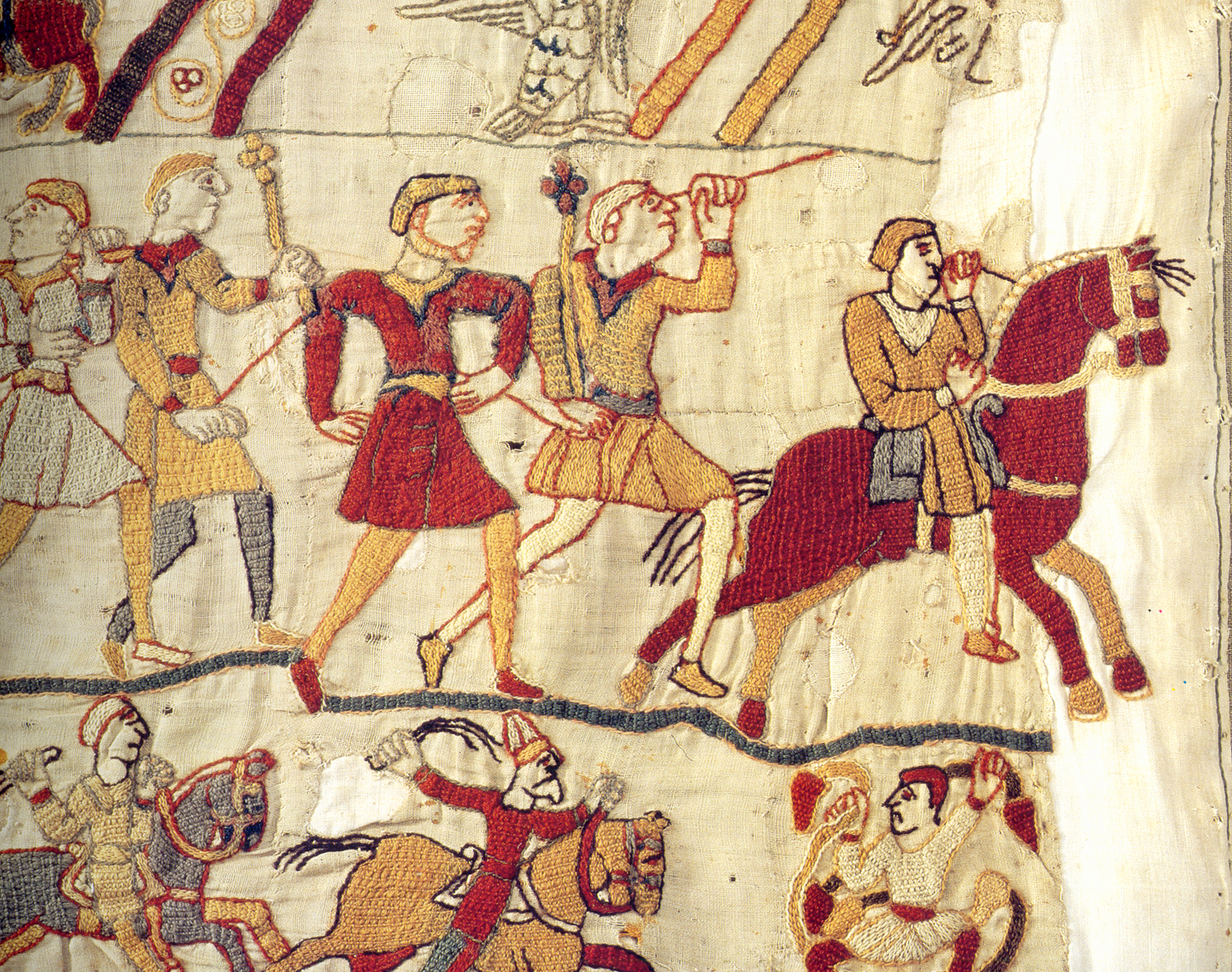
Scene 42 HIC COQUITUR CARO ET
HIC MINISTRAVERUNT MINISTRI (Here the meat is being cooked and here the
servants have served (it)) (By Image on web site of Ulrich Harsh -
http://www.hs-augsburg.de/~harsch/Chronologia/Lspost11/Bayeux/bay_tama.html,
Public Domain, https://commons.wikimedia.org/w/index.php?curid=1714213).

Scene 43a HIC FECERUN[T]
PRANDIUM (Here they have a meal) (By Image on web site of Ulrich Harsh -
http://www.hs-augsburg.de/~harsch/Chronologia/Lspost11/Bayeux/bay_tama.html,
Public Domain, https://commons.wikimedia.org/w/index.php?curid=17142140).

Scene 43b (cont) ET HIC
EPISCOPUS CIBU[M] ET POTU[M] BENEDICIT (And here the bishop blesses the food
and drink) (By Image on web site of Ulrich Harsh -
http://www.hs-augsburg.de/~harsch/Chronologia/Lspost11/Bayeux/bay_tama.html,
Public Domain, https://commons.wikimedia.org/w/index.php?curid=17142142).
Scene 43b (cont) ET HIC EPISCOPUS
CIBU[M] ET POTU[M] BENEDICIT (And here the bishop blesses the food and drink). William sits down to a feast with his nobles, and Bishop Odo says grace.

Scene 44 ODO EP[ISCOPU]S
WILLEM[US] ROTBERT (Bishop Odo, William, Robert) (By Image on web site of
Ulrich Harsh -
http://www.hs-augsburg.de/~harsch/Chronologia/Lspost11/Bayeux/bay_tama.html,
Public Domain, https://commons.wikimedia.org/w/index.php?curid=17142141).
Scene 44 ODO EP[ISCOPU]S WILLEM[US]
ROTBERT (Bishop Odo, William, Robert). Duke William appears in discussion with his half-brothers, Bishop Odo and Robert, Count of Mortain. Robert was a Norman nobleman, brother of Odo and
half-brother of William; a proven companion of William at the Battle of
Hastings who became one of the greatest landholders in William’s new Kingdom of
England.

Scene 45a ISTE JUSSIT UT
FODERETUR CASTELLUM AT HESTENGA (He ordered that a motte should be dug at
Hastings) (By Image on web site of Ulrich Harsh -
http://www.hs-augsburg.de/~harsch/Chronologia/Lspost11/Bayeux/bay_tama.html,
Public Domain, https://commons.wikimedia.org/w/index.php?curid=17142143).
Scene 45a ISTE JUSSIT UT FODERETUR
CASTELLUM AT HESTENGA (He ordered that a motte should be dug at Hastings). A motte is a mound forming the site of a castle or camp. This one was a type of castle built to strengthen the Norman invaders' base at Hastings.
_-_WGA24171.jpg)
Scene 45b (cont) CEASTRA (the
camp) in higher resolution detail (https://en.wikipedia.org/wiki/File:Tapestry_by_unknown_weaver_-_The_Bayeux_Tapestry_(detail)_-_WGA24171.jpg).

Scene 36 HIC TRAHUNT NAVES AD MARE (Here they drag the ships to the sea) (By Image on web site of Ulrich Harsh. - http://www.hs-augsburg.de/~harsch/Chronologia/Lspost11/Bayeux/bay_tama.html, Public Domain, https://commons.wikimedia.org/w/index.php?curid=17142096).
Scene 36 HIC TRAHUNT NAVES AD MARE (Here they drag the ships to the sea). Just to the right of this, Scene 37 shows provisions being brought to the ships.

Scene 37 ISTI PORTANT ARMAS AD NAVES ET HIC TRAHUNT CARRUM CUM VINO ET ARMIS (These men carry arms to the ships and here they drag a cart (laden) with wine and arms). Food and drink are brought down to the ships. So are weapons and armor, including coats of chainmail, helmets, sword, and lances.

Scene 38 † HIC WILLELM[US] DUX IN MAGNO NAVIGIO MARE TRANSIVIT ET VENIT AD PEVENESÆ († Here Duke William in a great ship crossed the sea and came to Pevensey). William leads his army to the ships; they embark and set sail, as the crossing of the channel begins. he sea is crowded with ships, filled with soldiers and horses. William sails in his ship, Mora, which was bought for him by his wife Matilda.

Scene 39 HIC EXEUNT CABALLI DE NAVIBUS (Here the horses leave the ships). On September 28, 1066, the Norman army arrives at the south coast of England, where they land at Pevensey.

Scene 40 ET HIC MILITES FESTINAVERUNT HESTINGA UT CIBUM RAPERENTUR (and here the knights have hurried to Hastings to seize food). Soldiers disembark and ride toward Hastings. [Hastings is a seaside town and borough in East Sussex on the south coast of England. The town gave its name to the battle what took place 8 mi northwest of it.]

Scene 41 HIC EST WADARD (Here is Wadard). Wadard, seated on a horse here, was a Norman nobleman who travelled to England with William and became a vassal of Bishop Odo.


Scene 43b (cont) ET HIC EPISCOPUS CIBU[M] ET POTU[M] BENEDICIT (And here the bishop blesses the food and drink) (By Image on web site of Ulrich Harsh - http://www.hs-augsburg.de/~harsch/Chronologia/Lspost11/Bayeux/bay_tama.html, Public Domain, https://commons.wikimedia.org/w/index.php?curid=17142142).
Scene 43b (cont) ET HIC EPISCOPUS CIBU[M] ET POTU[M] BENEDICIT (And here the bishop blesses the food and drink). William sits down to a feast with his nobles, and Bishop Odo says grace.

Scene 44 ODO EP[ISCOPU]S WILLEM[US] ROTBERT (Bishop Odo, William, Robert). Duke William appears in discussion with his half-brothers, Bishop Odo and Robert, Count of Mortain. Robert was a Norman nobleman, brother of Odo and half-brother of William; a proven companion of William at the Battle of Hastings who became one of the greatest landholders in William’s new Kingdom of England.

Scene 45a ISTE JUSSIT UT FODERETUR CASTELLUM AT HESTENGA (He ordered that a motte should be dug at Hastings). A motte is a mound forming the site of a castle or camp. This one was a type of castle built to strengthen the Norman invaders' base at Hastings.
_-_WGA24171.jpg)

Scene 46 HIC NUNTIATUM EST WILLELM[O] DE HAROLD[O] (Here William was told about Harold). A messenger brings William news of Harold and his army.


.jpg)
Scene 48 HIC MILITES EXIERUNT DE HESTENGA ET VENERUNT AD PR[O]ELIUM CONTRA HAROLDUM REGE[M] (Here the knights have left Hastings and have come to the battle against King Harold). (By Image on web site of Ulrich Harsh - Public Domain, <a href=https://commons.wikimedia.org/w/index.php?curid=17142145).

Scene 49 HIC WILLELM[US] DUX INTERROGAT VITAL[EM] SI VIDISSET HAROLDI EXERCITU[M] (Here Duke William asks Vital if he has seen Harold's army) (By Image on web site of Ulrich Harsh - http://www.hs-augsburg.de/~harsch/Chronologia/Lspost11/Bayeux/bay_tama.html, Public Domain, https://commons.wikimedia.org/w/index.php?curid=17142147 ).

Scene 50 ISTE NUNTIAT HAROLDUM REGE[M] DE EXERCITU WILLELMI DUCIS (his messenger tells King Harold about Duke William's army) (By Image on web site of Ulrich Harsh - http://www.hs-augsburg.de/~harsch/Chronologia/Lspost11/Bayeux/bay_tama.html, Public Domain, https://commons.wikimedia.org/w/index.php?curid=17142148).

.jpg)
.jpg)

Scene 52a HIC CECIDERUNT LEWINE ET GYRD FRATRES HAROLDI REGIS (Here fell Leofwine and Gyrth, brothers of King Harold). On the far left of the same scene, Duke William, on a black horse, leads the charge at the start of the battle. As arrows and lances fly through the air, many men lie dead or wounded on the battlefield (on the lower border of the tapestry). The English soldiers, who are all on foot, protect themselves with a wall of shields.

Scene 52b HIC CECIDERUNT LEWINE ET GYRD FRATRES HAROLDI REGIS (Here fell Leofwine and Gyrth, brothers of King Harold). The violence continues as men hack and spear each other to death. Harold's brothers both die fighting.

_-_WGA24165.jpg)

Scene 54 HIC ODO EP[ISCOPU]S BACULU[M] TENENS CONFORTAT PUEROS (Here Bishop Odo, holding a club, gives strength to the boys). Bishop Odo appears in the thick of the fighting, waving a club and encouraging his followers. Odo uses a club rather than a sword, since bishops were not supposed to shed blood.

Scene 55 HIC EST WILLEL[MUS] DUX (Here is Duke William). After a fall from his horse, William raises his helmet to reveal his face. This shows his troops that he is still alive and encourages them to continue fighting. To his right, Count Eustace carries an elaborate banner, which may be the one given by the Pope to show his support for William's invasion of England.

commons.wikimedia.org).jpg)
.jpg)

November 24, 2023 - Scene 56b HIC FRANCI PUGNANT ET CECIDERUNT QUI ERANT CUM HAROLDO (Here the French are fighting and have killed those who were with Harold).

.jpg)
.jpeg)
The figure standing below the part of the inscription with the name "Harold" is currently depicted gripping an arrow that has struck his eye. This, however, may have been a late 18th- or early 19th- century modification to the Tapestry. Some historians have questioned whether this man is intended to be Harold or if the panel shows two instances of Harold in sequence of his death: the figure standing to the left of the central figure commonly thought to be Harold, and then lying to the right almost supine being slain with a sword and mutilated beneath a horse's hooves.

November 24, 2023 2:10 PM - Viking Star: Bayeux Tapestry Tour - part of same Scene 57 HIC HAROLD REX INTERFECTUS EST (Here King Harold was slain), with Wing Commander (ret.) William Simpson; here, the yellow arrow is barely visible.

Scene 58a ET FUGA VERTERUNT ANGLI (and the English have turned in flight). With Harold dead, the battle is over. The victorious Normans chase the remaining English from the battlefield. The final scene from the tapestry has been lost. It may have shown William being crowned King of England. This would match the scene at the very beginning of the tapestry, which shows King Edward secure on the throne just two years earlier.

Scene 58b ET FUGA VERTERUNT ANGLI (and the English have turned in flight) in higher resolution detail. The English fleeing.


_-_WGA24171.jpg)


_-_WGA24165.jpg)


No comments:
Post a Comment